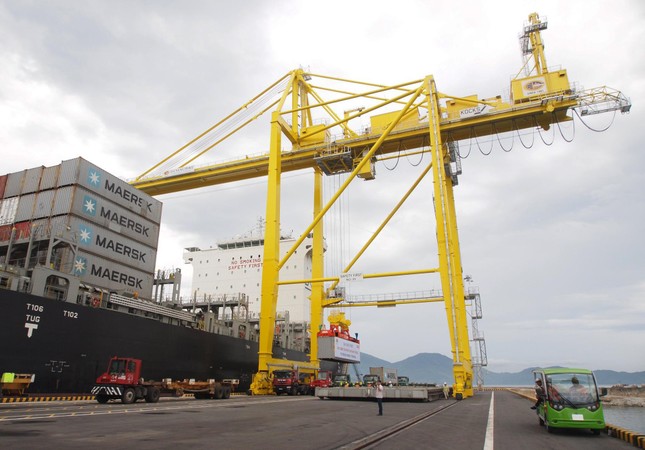

On August 4, Da Nang City People’s Committee held a forum on the development of logistics services on the East-West Economic Corridor (EWEC). Experts believe that it is necessary to develop breakthrough mechanisms and policies to attract investors to participate in the logistics service chain on this corridor.
Asynchronous infrastructure
Initiated in 1998 with a length of 1,450 km, EWEC stretches across 4 countries, starting from the port city of Mawlamyine in Myanmar, passing through Thailand and Laos and ending at Da Nang city in Vietnam. The corridor is expected to create a driving force for development, attract investment, and promote cross-border trade connections.
However, according to Mr. Tran Phuoc Son, Vice Chairman of Da Nang City People’s Committee, after nearly 25 years of establishment, EWEC has not yet received proper investment attention from countries to become a real cross-border economic corridor. “Transport infrastructure as well as industrial, commercial and service infrastructure are still underdeveloped. The size of the market for production and consumption of goods is small, which leads to the fact that logistics services on the corridor are not really developed,” said Mr. Son.
Mr. Duong Tien Lam (representative of the Vietnam Association of Logistics Service Enterprises in Da Nang) said that logistics activities on this corridor are not effective. He added: “A shipment from Da Nang to Yangon (Myanmar) takes up to 28 days, which reduces the value of goods and competitiveness.”
The reason that this container shipment took about 25 days to arrive in Yangon is that at each border gate, the goods must be loaded and unloaded to the vehicle of the host country. Container trucks from Vietnam, if they want to run into Laos to avoid having to load, also take a long time to complete the procedures. However, after that, the container was forced to transfer to the Thai truck and then again to the Myanmar truck. In addition, the journey was further delayed because each country used its own customs declaration instead of the ASEAN Customs Transit System (ACTS) which was put into use by the end of 2020.
Mr. Pham Hoai Chung, Deputy Director of the Institute of Transport Strategy and Development, also assessed that the East-West Economic Corridor route has many barriers and bottlenecks in terms of infrastructure. The connection from Myanmar to Laos and Vietnam has asynchronous infrastructure, leading to interrupted transport operations and very high logistics costs.
“Currently, Thailand’s transport system has different standards from those in Laos and Vietnam. Thus, there must be policy reforms to build favorable transport agreements, how to pass through the border gates without having to lift the container up and then transfer it to the vehicle of the second country.” said Chung.
A breakthrough policy is needed
At the forum, Mr. Nguyen Cong Bang, Deputy Director of the Transport Department (Ministry of Transport) suggested that it is necessary to develop breakthrough mechanisms and policies to attract potential businesses and investors in the field of logistics to participate the logistics service chain on the East-West Economic Corridor.
Mr. Le Duc Tien, Vice Chairman of Quang Tri Provincial People’s Committee, agreed that it is necessary to develop a number of key logistics enterprises in the region, and at the same time have policies to support these businesses.
“The Vietnam’s Ministry of Industry and Trade and other ministries and branches need to support localities located on EWEC to improve staff capacity in logistics service management; formulate policies to support the implementation of a number of logistics development activities,” said Mr. Tien.
According to Mr. Tran Thanh Hai, Deputy Director of the Import-Export Department, Ministry of Industry and Trade, there should be preferential policies to support the development of logistics enterprises. Mr. Hai stressed the city needs to focus on speeding up the implementation of key infrastructure projects such as: Urban areas around seaports, Kim Lien cargo terminal and Lien Chieu Industrial Park, New Lien Chieu port, the relocation project of railway stations, road upgrading projects (national highways 14B, 14G…). “In addition, Da Nang needs to have preferential policies to support logistics service enterprises to apply high technology in their operations, support trade promotion, and call for investment in hi-tech logistics centers.” said Mr. Hai.